“Cars run on gas, the economy runs on diesel,” says Mark Zandi, chief economist at Moody’s.
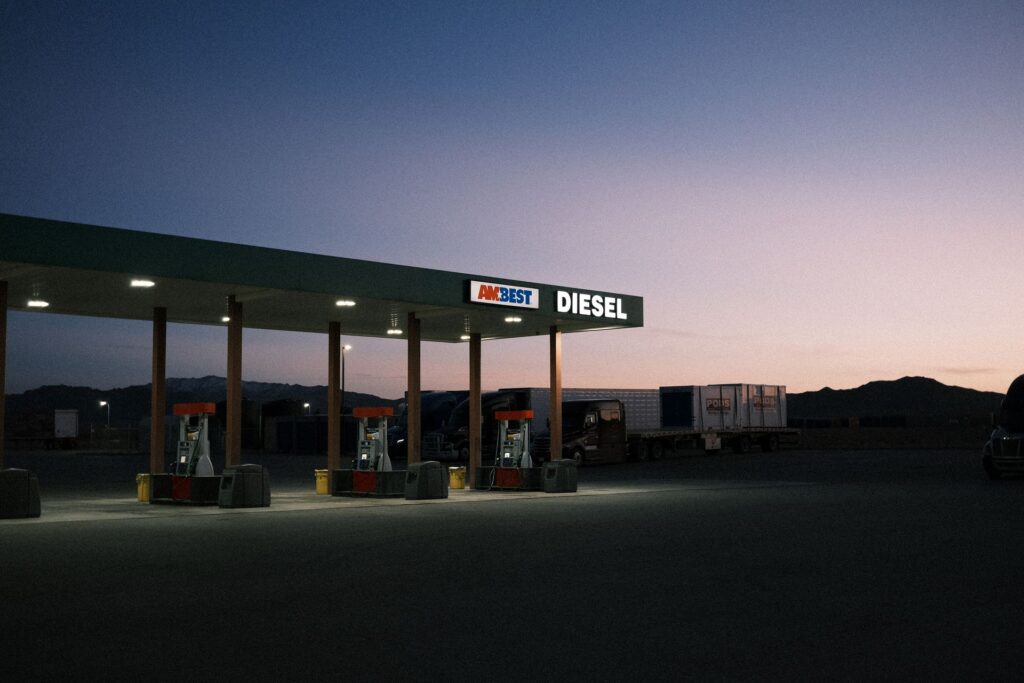
Americans feel rising gas costs every time they fill up their tanks, but the impact of diesel goes much further than the pump. According to the U.S. Energy Information Administration, the national average price for a gallon of diesel is now $6.28, up 68% from $3.74 a year ago. The increase is largely attributed to the U.S. war with Iran and the Russia-Ukraine war. Because diesel powers the trucks, tractors, and combines that keep the economy moving, the effects reach everything from freight rates to farm budgets to the price of your groceries. Here’s how it plays out across each link in the chain.
How Truck Drivers are Impacted by High Diesel Prices
Trucking is where the pressure begins, and independent owner-operators are hit hardest. Large carriers like UPS or J.B. Hunt can buy diesel wholesale through terminal contracts with big discounts, or pass fuel costs along to enterprise shippers and retail consumers. Small operators usually pay out of pocket at the pump and absorb every extra cent. Fuel is their largest variable expense, and they often wait weeks to get paid without a deep cushion of capital. A sustained spike can threaten the viability of a small business and push some owners out of the industry entirely. That matters for the whole supply chain, since The New York Times reports that 92% of trucking companies are small operations running 10 or fewer trucks.
Drivers say the strain is already showing. Fox 26 spoke with Tyrell Robinson, an independent driver of more than eight years, at a Houston truck stop. “It’s insane. It’s really hindered a lot of us drivers out here, for sure. Rates are low and plus the fuel is high,” he said. Robinson reports spending over $3,000 a week on diesel, all out of pocket, but he plans to keep trucking and expects prices to improve with time.
Drivers in other parts of the country tell a similar story. WALB News 10 in Albany, Georgia, spoke with Yahathan, a driver of 28 years, who said, “We’re going to automatically spend over $2,000 a week on fuel.” Unlike company drivers, he explained, owner-operators have to watch fuel spending closely to keep their businesses afloat. Because he covers every fuel cost himself, Yahathan has started cutting back on routes to save money. He isn’t alone. Many drivers are being far more selective about the routes they accept, and The New York Times reports that some are spending as much as $1,400 per tank, so tightly controlling fuel burn has become essential.
Where drivers fill up matters too. According to Fortune, several pumps in California have maxed out their displays, with diesel reaching $9.999 a gallon. Drivers heading west to east are often advised to skip California and refuel in states like Nevada or Arizona instead. Extra stops are rarely ideal when time is money, but with prices this high, many find the detour worth it.
How Rising Diesel Prices Impact U.S. Farmers
Trucks aren’t the only machines running on diesel. According to the Engine Technology Forum, more than two-thirds of all U.S. farm equipment runs on it, and the timing couldn’t be worse, with prices at record highs during harvest season. Farmers can buy off-road diesel, which isn’t subject to federal and state taxes, but even with that discount many are paying much more for fuel than in previous years. An economist at Purdue University estimates that farm fuel costs are up $7 per acre for soybeans and $11 per acre for corn.
For farmers, the numbers add up quickly. Addie Yoder, a corn, soybean, and cattle farmer in northeast Missouri, told Reuters she runs two combines, three semi-trucks, and several tractors each fall to harvest and transport her crops. At current prices, a single combine needs 300 gallons of diesel a day. In southeast South Dakota, Drew Peterson, a corn, soybean, and cattle farmer, expects to spend up to $1,500 per day fueling just one of his combines this season. That is double last year’s cost, and that’s only one of the many machines he needs. “You can’t just say, well, diesel is expensive, I’m not going to harvest. You’ve just got to make it work in your budget,” he said.
Economists and farmers alike worry that profit margins are becoming razor-thin. If farmers struggle to keep their operations afloat, those costs are likely to be passed on to consumers.
Consumers Could Face Further Price Increases on Everyday Goods and Food due to High Diesel Costs
That brings the impact to everyday shoppers. Gas prices hit consumers’ wallets directly, but diesel’s effect is indirect and just as real. As Zandi puts it, “Anything that’s on a truck will be impacted by the higher diesel costs, everything from groceries to whatever you’d get delivered to your front door by UPS or Amazon.”
The data is beginning to show it. Reuters reported that in September, the cost of truck freight transportation was up 19% year over year, the largest increase in just over four years. Prices for energy-sensitive feed products like corn, hay, and oilseeds are up more than 25% from a year ago, and economists expect a pickup in food inflation later this year.
Food isn’t the only category affected. Toy prices rose in September by the most ever month over month, according to Reuters, as companies faced higher shipping costs on top of other pressures like tariffs. With the holidays approaching, shoppers may feel it soon.
What This Means for the Logistics Industry
Rising diesel prices touch every stage of the supply chain, from the owner-operator at the pump to the farmer in the field to the family at the checkout. For logistics providers, shippers, and the drivers who move freight, the lesson is that fuel costs rarely stay in one place. They travel through freight rates, production costs, and finally retail prices. Until prices ease, planning around fuel, whether through route optimization, smart fueling strategies, or transparent conversations about rates, will remain essential to keeping freight moving and businesses profitable.