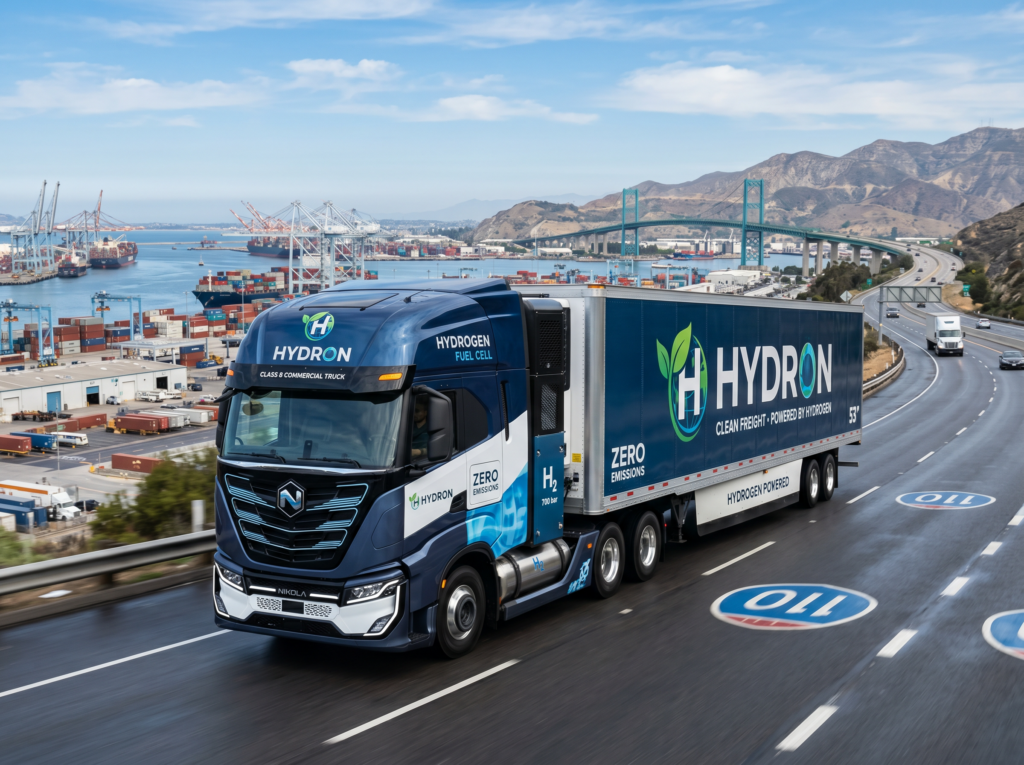
Toyota Motor North America continued it’s major investment in hydrogen-powered trucking, but one challenge continues slowing widespread adoption: refueling infrastructure.
Hydrogen itself is the most abundant element in the universe, making up roughly 75% of ordinary matter by mass and 90% of all atoms.
Pace Logistics Lab continued our reporting last year on the continuing development of hydrogen fuel cells as alternative energy sources for commercial trucks and freight transportation. As a reminder, hydrogen fuel cells are carbon free. They produce electricity for power, with their only byproducts being water and a minimal amount of heat. No carbon monoxide, nitrogen oxides, or particulates to pollute our atmosphere.
The technology is early stage, and one continuing issue is relative expense versus conventional fuels for powering trucks. But research and development continues because of the potential benefits of hydrogen.
Benefits of Hydrogen Fuel Cell Powered Trucks Include:
- Zero emissions
- Quietness
- Long range capabilities
- Relatively quick refueling
- Flexibility of applications
Toyota Motor North American Deal with Hyroad Energy Announced
On May 4, Toyota Motor North American announced a collaboration with Hyroad Energy to deploy 40 hydrogen fuel cell Class 8 commercial trucks in California. Hyroad, a pioneering company in hydrogen-powered transportation solutions, acquired 117 hydrogen fuel cell trucks last August, including spare parts and software, from Nikola Corporation’s bankruptcy auction. Toyota will supply the hydrogen itself through refueling infrastructure it has under development in Ontario, California — a notable detail, since the deal pairs Hyroad’s trucks and fleet software with Toyota’s own fuel supply rather than relying on third-party stations.
Hydrogen Refueling Stations: Why Availability Is the Key Factor
Although Toyota Motor North America said their focus is on developing its own hydrogen refueling infrastructure only in California, there are other promising developments. But the infrastructure picture is thin and, at the moment, fragile. California — the epicenter of U.S. hydrogen trucking — has roughly 65 to 90 retail hydrogen stations depending on the count, against a state goal of 200. In March 2026, a fatal explosion at a hydrogen delivery trailer operated by Pilot Company disrupted compressed-hydrogen supply into Southern California, and as of that reporting roughly 35 of the state’s retail stations were out of service at once. It was a stark illustration of how thin the margin for error still is: a single upstream incident can knock out a meaningful share of an already-small network.
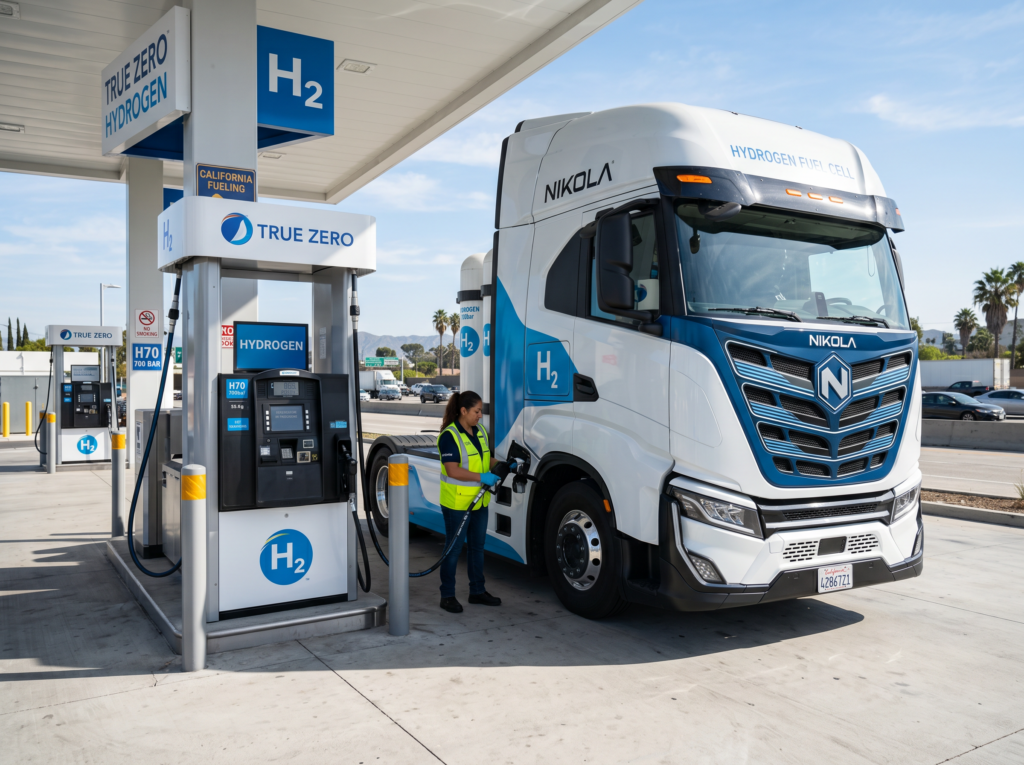
A network still measured in the dozens, in the state most committed to it, shows how far hydrogen trucking infrastructure has to go. The U.S. Energy Information Administration (EIA) and other industry sources have consistently placed the number of gasoline and diesel fueling stations around 150,000 in recent years. There are roughly 200,000+ EV charging ports around the country, and still growing, though estimates vary by source and methodology.
So why the investment in developing hydrogen fuel cells to produce electricity power for trucks versus straight up EV trucks?
Reasons for Developing Hydrogen Fuel Cell Trucks versus Pure EV Trucks
- Hydrogen has a much higher energy density by weight than lithium-ion batteries. This is critical for trucks, which need to haul heavy loads over long distances.
- A hydrogen fuel cell truck can achieve 400–500+ miles of range without the massive weight penalty of a large battery pack.
- Hydrogen refueling takes roughly 10–20 minutes, like diesel. This is crucial for commercial trucking where time is money and drivers operate on tight schedules.
- Battery EV trucks, even with fast charging, can take 1–2+ hours for a meaningful charge — a significant operational disruption.
- Large battery packs for long-range trucks can weigh 10,000–20,000 lbs., directly cutting into payload capacity (trucks are limited by gross vehicle weight regulations).
- Hydrogen fuel cell systems are significantly lighter, preserving more of the legal payload capacity.
- Batteries lose significant range and charging efficiency in cold temperatures. Hydrogen fuel cells are less affected, making them more reliable in northern climates and winter conditions.
- The heavier and longer the haul, the more the math favors hydrogen. For Class 8 semi-trucks doing transcontinental routes, the weight and range challenges of batteries become increasingly difficult.
Within the industry there is a debate as to whether hydrogen fuel cell powered trucks or battery powered EV trucks will eventually predominate in the non-fossil fuel space. Currently the advantages of hydrogen fuel cell powered trucks are limited due to the refueling infrastructure limitations. This means that hydrogen powered trucks are deployed mainly for heavy-duty, long-haul freight; short-haul urban routes go to battery powered EV trucks.
For the realization of hydrogen powered truck benefits, it’s largely the proverbial chicken and egg problem, a circular dependency where if we are to have more hydrogen powered trucks on the road, there need to be more fueling stations. Investing in more hydrogen fueling stations is not necessarily viable unless there are more hydrogen fuel cell powered trucks. It’s not clear at this stage which event will be the cause, and which will be the effect.
Federal Policy Has Made the Egg Harder to Find
The chicken-and-egg problem just got harder to solve from the federal side. The Bipartisan Infrastructure Law set aside $7 billion for seven regional “hydrogen hubs” meant to seed exactly this kind of producer-to-trucker ecosystem. Since early 2025, the Department of Energy has moved to cancel roughly $2.2 billion in awards to two of those hubs — ARCHES in California and the Pacific Northwest Hydrogen Hub — and floated reviewing funding for the rest. ARCHES paused its hydrogen hub activities in November 2025 and is now leaning on state programs, including California’s cap-and-invest revenue and its Clean Truck and Bus Vouchers, to keep projects alive. The 45V production tax credit for clean hydrogen survived 2025’s budget bill but on a shorter runway, with the construction-start deadline pulled forward from 2033 to 2028. None of this kills hydrogen trucking outright, but it shifts more of the infrastructure burden onto states and private capital at exactly the moment the technology needs predictable, patient money.
So, it’s a conundrum. Getting refueling infrastructure wrong or planning it much later than vehicle adoption can lead to idle trucks, a wasteful and expensive proposition. As a result, the current situation is strategically placed hydrogen freight corridors only in regions with extremely high freight traffic. This means routes with predictable patterns, and trucks returning to central hubs or traveling well defined regional corridors. A start, perhaps, but still extremely limited in geographic scope. Hence, Toyota investing in California only.
However, it’s important to remember that as gasoline powered automobiles and trucks were first being introduced in the early 20th century, a combination of private fossil fuel company investment and public sector road building transformed refueling from simple roadside fuel barrels to what became known as the “filling station.” These stations eventually morphed into automobile repair and servicing, and then into the roadside convenience store concept we all know, and eventually into hubs for food, lodging, and entertainment along major highways. Demand drove supply.
The Takeaway: What’s Next for Hydrogen Fuel Cell Trucks
The filling-station era is a genuinely useful precedent, but it’s worth being honest about where it breaks down. Early gasoline infrastructure had a captive market — once someone bought a car, there was no other way to fuel it — and it scaled in an era without an entrenched, federally subsidized competitor. Hydrogen trucking has neither advantage. It’s competing for the same zero-emission freight dollar as battery-electric trucks, which already have a head start in infrastructure, falling costs, and now in federal favor. That doesn’t make the chicken-and-egg problem unsolvable. “While hydrogen has clear advantages for long-haul freight, widespread adoption will ultimately depend on infrastructure. Until fueling networks expand, hydrogen will likely remain focused on major freight corridors rather than replacing diesel nationwide.” We’ll keep tracking it here.